FPV (First Person View) - controlling a drone via on-board video. How FPV differs from classic UAVs, what it consists of, and what classes exist by size and purpose
FPV drone (from the English First Person View - "first person view") is an unmanned aerial vehicle that the operator controls using a video image from an on-board camera in real time, through glasses or a monitor. The operator sees the flight as if sitting "in the cockpit" of the device. In Ukrainian practice in 2022-2026, the term "FPV drone" most often refers to maneuvering quadcopters assembled for specific tasks: strike, bombing, reconnaissance, relay, interception of air targets and logistics.
Below is an analysis of the term, structure and two practical classifications: by frame size and by purpose. The material is designed for the purchaser, not the hobbyist pilot: the emphasis is on how the class of the device determines its design and, accordingly, the requirements for production.
Where did the term FPV come from
The abbreviation FPV stands for First Person View. The term was born in the environment of aeromodelling and drone racing in the 2010s: a camera on board, a video transmitter, glasses for the operator - and the device is controlled "from the board", and not by observation from the ground. The initial purpose of such systems was purely recreational: sports racing and dynamic filming, where the main requirements were maneuverability and minimal video signal delay.
Since 2022, the technology has been adapted for military tasks, and the sector has gone from amateur assemblies from imported kits to standardized mass production. An important terminological detail: in international sources, FPV is primarily a control method (any drone with a camera and video link can fly "in FPV mode"), while in Ukrainian military practice, an "FPV drone" has become established as a separate class of equipment. Both uses are correct, just the contexts are different.
How does FPV differ from a "classic" UAV
The main technical difference is in the philosophy of control and stabilization.
| Characteristics | Commercial multicopter (like DJI Mavic) | FPV drone | Airplane-type UAV |
|---|---|---|---|
| Stabilization | Full autopilot, the device "hangs" by itself | Minimal or none: manual control (acro-mode) | Autopilot, inertial navigation |
| Navigation | Dependent on GPS/GNSS | Mostly visual, via camera | GPS + INS |
| Control | From the operator's perspective on the ground | "On board", by video signal | Route-based |
| Design priority | Shooting quality, stability | Maneuverability, speed, payload | Range, flight duration |
A classic commercial drone maintains its position thanks to satellite navigation and autopilot algorithms - it forgives the operator for pauses. FPV in the basic configuration flies only as long as the pilot continuously adjusts the thrust and angles: this requires training, but gives maneuverability and independence from GPS. The delay of the video signal in combat FPV systems is typically kept within tens of milliseconds - that is why the camera here is "sharpened" not for cinematic quality, but for minimal latency.
What does an FPV drone consist of
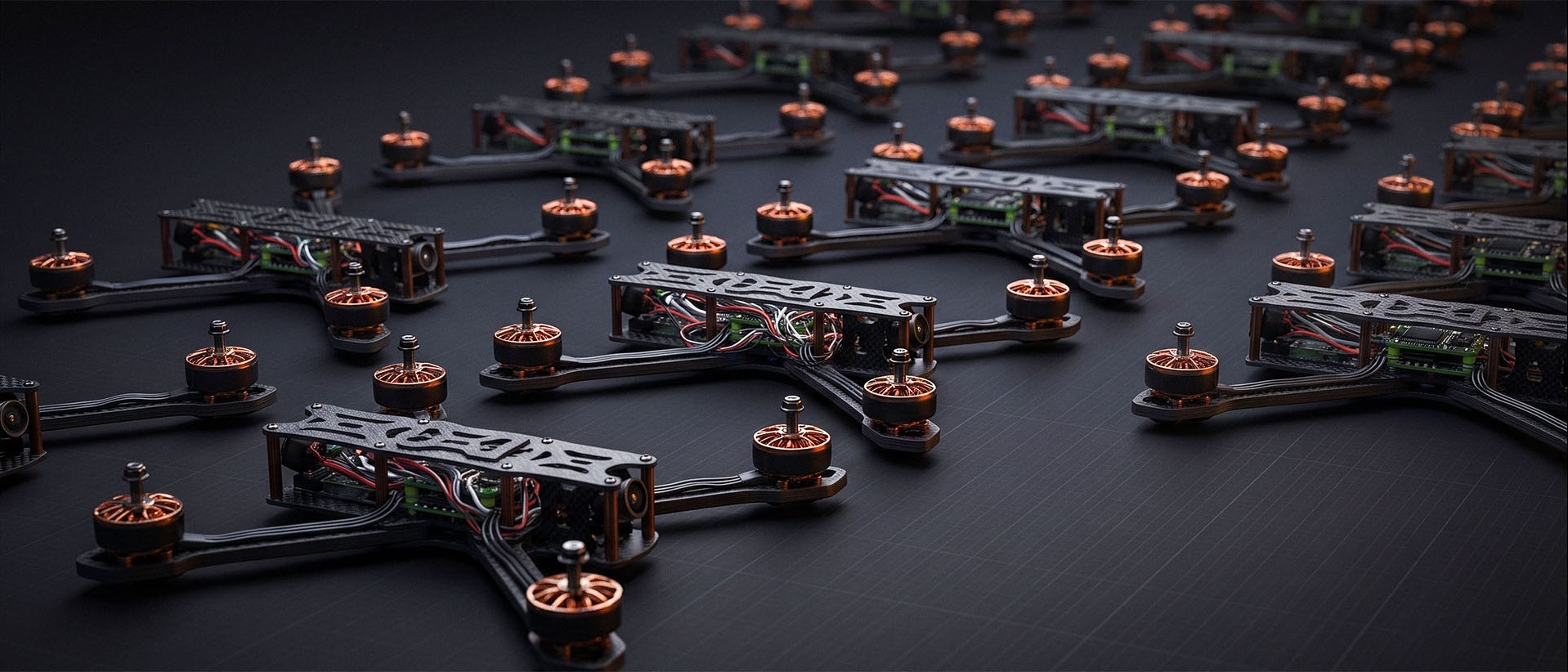
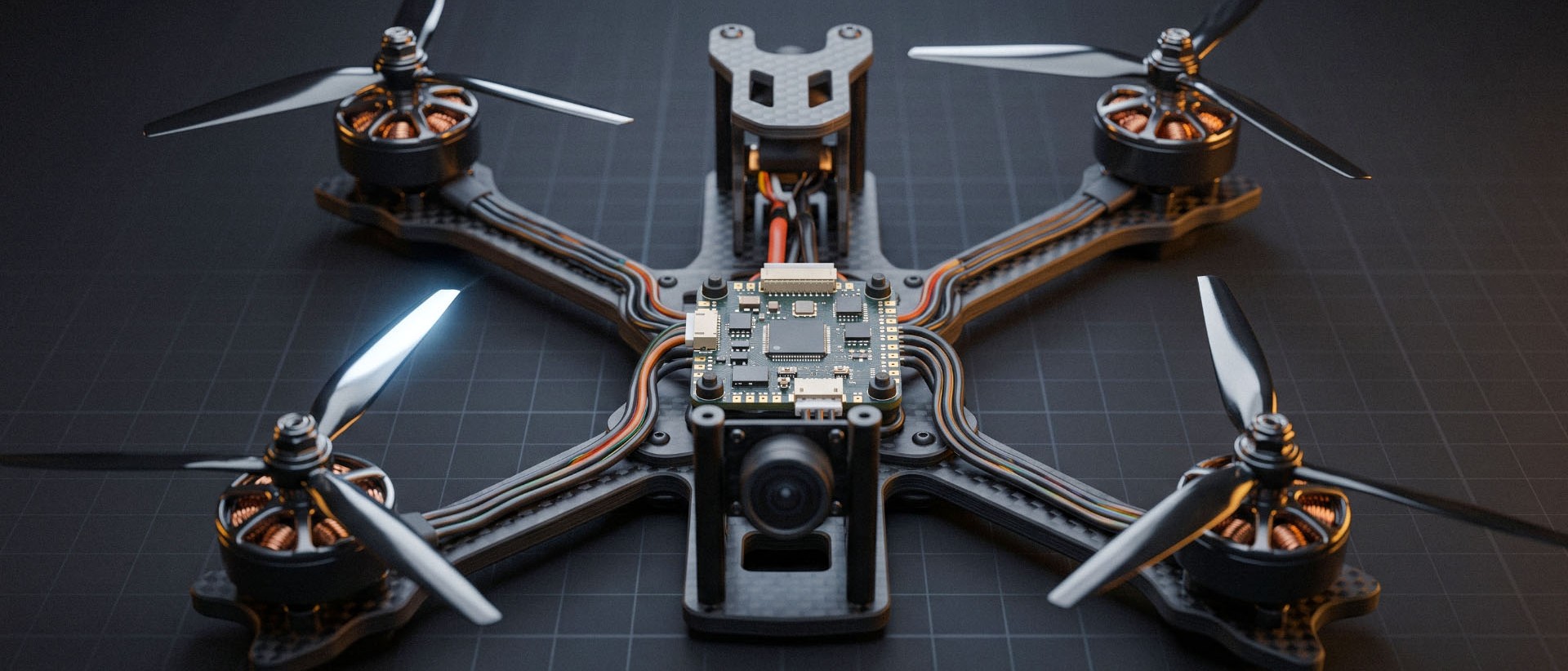
The FPV component base is standardized, and this is what makes serial assembly possible. Basic composition:
- Frame - a supporting structure, most often made of carbon fiber. The diagonal of the frame in inches is the main classification parameter (1" = 2.54 cm). Geometry also matters: the symmetrical True-X gives maximum reactivity, the Deadcat with spread front arms removes propellers from the camera's field of view, the H-frame is convenient for bulky payloads.
- Propulsion group - brushless motors with propellers. The motor size is encoded with a four-digit number (diameter and height of the stator in mm), and the KV parameter shows the revolutions per volt: large propellers of heavy platforms require low KV, small high-speed ones - high KV.
- Stack - flight controller (FC) plus electronic speed controllers (ESC), mounted in a block in the center of the frame. The controller reads the gyroscope, accelerometer and barometer and converts operator commands into motor control.
- Video path - course camera, video transmitter (VTX) and antennas.
- Control channel - radio receiver (RX) with control protocol and configured failsafe logic.
- Power supply - LiPo or Li-ion batteries; battery configuration directly limits flight time and payload weight.
- Payload - a module for a specific class task; its weight, dimensions and attachment points are specified in the technical specifications.
Each of these items is a separate line of the specification when ordering a series. The more fully they are described, the more accurate the estimate and the shorter the deadline: how to fix them exactly - in our specification requirements checklist.
Analog, digital or fiber optic
Based on the type of video transmission, FPV systems are divided into analog and digital. Analog offers minimal latency and degrades gradually (the image becomes noisy but remains visible), while digital provides noticeably better detail at the cost of a higher price and more abrupt signal loss in the event of interference. A separate trend for 2025-2026 involves drones with fiber-optic transmission: the signal travels through a cable that uncoils behind the drone. This type of transmission is not affected by radio interference, but adds significant weight from the cable reel and is susceptible to mechanical damage to the line on rugged terrain. The choice of transmission path is a design decision made by the owner to suit the task; for manufacturing, this simply translates to different BOM items and different test program entries.
Classes by frame size
The frame diagonal determines the maximum propeller size, and thus thrust, energy efficiency, and payload capacity. The basic physics are simple: a larger propeller means higher cruising efficiency, but also greater inertia and lower responsiveness.
| Class | Typical role | Approximate payload | Note |
|---|---|---|---|
| 5" | High-speed and tactical missions, training | up to ~0.5 kg | The benchmark for speed/maneuverability balance |
| 7" | Most common platform class | ~1-2 kg | Mass-produced workhorse |
| 8" | Intermediate class | ~2-2.5 kg | Higher efficiency while maintaining compact dimensions |
| 10" | Heavy platforms | ~2.5-4 kg | Priority: stability and payload, not maneuverability |
| 13-15"+ | Super-heavy: bombers, relay drones, transport | ~5-9+ kg | Specialized low-KV motors, large batteries |
There are also smaller drones (3" micro-class) and larger multi-purpose platforms up to and including 17" - specifically those classified by the Ministry of Defense. The payload ranges in the table are approximate: published specifications for specific platforms vary across sources, so when ordering a series, the starting point is not the "class in general," but your technical specifications and the approved reference model.
Classes by purpose
Size has long ceased to be the sole classification criterion - purpose dictates design just as much:
- Disposable strike platforms - the most widespread segment. Philosophy: maximum cost reduction while maintaining the necessary flight characteristics; the battery is designed for a single flight, and the video feed is most often analog.
- Bombers - reusable aircraft with a payload release mechanism: large frames (10"+), energy reserve for return flight, and balancing designed for variable payloads.
- Reconnaissance drones - priority given to flight time and image quality, often equipped with night vision or thermal imaging cameras.
- Relay drones - high-altitude platforms (13-15") that extend the range of other drones; a characteristic feature is large directional antennas and cross-band transmitters.
- Interceptors - the newest class (2025-2026): aircraft designed to engage aerial targets. They differ the most in design: streamlined domes instead of open platforms, powerplants optimized for maximum speed, and target-tracking modules. The claimed speeds of combat interceptors are in the range of 160-330 km/h; records set by sports frames at 600+ km/h cannot be transferred to combat systems carrying payloads.
- Logistics platforms - heavy multirotors with interchangeable transport modules; this is often a multi-purpose platform configuration rather than a separate model.
How class determines the layout
For customers ordering a series, this is the most practical section: class isn't just a label, but a set of design implications.
The size dictates the powerplant and energy system. Lightweight classes use high-KV motors and compact LiPo batteries; heavyweight classes use low-RPM motors, large propellers, and high-capacity batteries, including Li-ion packs built with 21700 cells. This leads to a trade-off that must be specified in the technical specifications: every additional kilogram of battery weight reduces either payload or range.
Battery placement determines flight behavior. A battery on the top plate brings the center of mass closer to the propeller plane and increases responsiveness (standard for high-speed platforms); bottom placement acts as a pendulum and stabilizes flight (standard for heavy bombers).
The mission determines the payload configuration. In a single-use strike platform, the layout is simplified as much as possible. In a bomber, the drop mechanism shifts the center of mass and alters the camera mounting. In a relay drone, volume and mass are allocated to antennas and communications. An interceptor features fairings and autopilot sensors.
For production, all this means one thing: each class has its own technical roadmap, its own reference model, and its own testing program. That is why flight testing of each aircraft is conducted according to the criteria specified in the customer's technical specifications, rather than according to "general FPV standards," which do not exist.
Our production line handles platforms ranging from 5" to 10"; fixed wings are available upon request. From an assembly perspective, the difference between classes isn't simply a "larger or smaller frame," but rather a different standard, different torque specifications, different wiring harness routing, and a different set of inspections: each configuration is developed into its own process chart before series production begins. That's why the first thing we ask the customer for isn't the class name, but the complete technical specifications: the class is just a starting point; the specification determines the series. - Chief Engineer of the KRYLACHI Line
If you have your own design or ready-made technical specifications for any of these classes, we provide contract assembly of FPV drones from pilot batches to series production, complete with a reference sample and a test log for each unit.
Data on classes and specifications are from open sources as of July 2026; public technical specifications for specific platforms vary between sources, so the ranges provided are approximate.